Recente Posts

Showing posts with label Uniformen. Show all posts

Sunday, 9 January 2022

Uniform or court suit Knightage Counsel Province of Utrecht under William I, king of the Netherlands/Uniform Ridderschap van de Provincie Utrecht

I bought this uniform from a longtime collector. It was clear that it was a uniform belonged to a nobel person who was a member of the Knightage Counsel of Utrecht. This can be indicated by the button. This kind of uniform is seldom or not to say, never, been offered on the market.


There is not much to find on the internet about the uniform. So I went to the archives in Utrecht to look into the existing files of the Knightage Counsel Utrecht. A complete new world of history came alive. 

It all started in the middle ages when nobel men where in controle (beside the church) over the common people. Over the century’s they gained a wild range of privileges but the way they reign was slightly changed by the new upcoming power: the cities. But the nobility in Holland was keen enough to take part in the newly political atmosphere. So three branches where made in 1588; cities, church and the nobility. It meant a little step backwards but the nobel men where still in controle. That changes with the French Revolution. They lost all of there powers and where stript naked as it came to priviliges. With Napoleon in charge nothing changed to the benefit for the nobility. But in 1815 with Napoleon sent to St.Helena, Holland crowend his king William I. William however was not willing to listen to the echo of the French Revolution, like in other countries, and set the clock backwards. The nobility was once again instituted, just one year later in 1816 as a reigning power in the Provinces (!) So they regained there power as before the French Revolution. By1850 (after the revoltion periode of 1848 in Europe) the Counsel was abolished permanetly.


                                The little black loop on the shoulder is to attache the cape

On 21 november 1818 (No, 50) King William I granted the Knightage Counsel of the Province of Utrecht to wear, in Dutch, a ' klein (minor) kostuum'. This means either a uniform or suit depending the time and context. It seams that the intention was to wear a costume/suite rather than a uniform. The nobility was wearing his costumes in a pre-revolution way and they want to succeed to that. The only problem was the fact that court costumes where never regulated (apart from uniforms) and Willem I insited that they did. But the nobel men refused to wear an uniform so they asked for regulation of there suites or costume. King William agreed but told the Knightage to draw, design or simply made a discription of there own costume for only the gouverment was responsable for uniforms. And in 1818 the first costume was regulated. It was a so called 'klein kostuum'. That means a minor costume for daily use. A year later the Knightage Counsel was granted a red major costume, called the court dress and only to be worn when visiting the court of William I. The discription (axtracted from the archives and formal decreet no.50) of the blue minor dress is as follows: 

a. a blue 'frak', 
b. embroidered with a laurel leave on the collar and cuffs,
c. buttons with a helmet reading: Ridderschap der Provincie Utrecht
d. a white vest, 
e. grey pair of trousers or white knee trouser with white silk stockings,
f.  if the grey trousers where in use men should wear a pair of black high boots with gilded spurs, 
g. a head with white plume and gold wire thread, 
h. a gilded court sword.

The drawing of the laurel in the archives

This means that the blue uniform (actually a suit) is the minor one. But it is completely wrong according to the discription. It is a uniform instead of a suit. The name on the button is abbreviated. The pocket flaps are also embroidered. and the style is late 19e or beginning 20th century. It should have looked like the picture on the right. So what went wrong? I contacted the well know musea who have a large collection of Dutch civil uniforms. And just one had precisly the same uniform. We compered the foto's and came to the conclusion that both where made by the same tailor. The curator told me that 3 pairs of uniforms (the minor blue one and the major red court dress) where made by Van Zanten in Zeist in or around 1910 (!). The museum owned the blue uniform but not the red court dress. Two red court dresses are in the museum Het Loo at Apeldoorn and one red court dress resides in the museum Van Loon. So they are not longer available for the collectors market. The other blue uniform is either gone for good or in private hands. But if this is a 1910 uniform where are the suits or costumes from 1818/1819? But first let us go to the red court dress of the Knightage Counsel, 

At 30 august 1819 (No. 8) king William I granted the Counsel to wear, in Dutch, 'groot (major) kostuum'. That is the dress/suit or costume that is only to be worn at his majesty court. The specifics are:

a. scarlet red 'frak',
b. five in gold wire embroidered bows in front, gold wire embroidered bows on the collar and the same on the cuffs,
c. a white vest en knee trousers,
d. a head with white plume and gold wire thread
e. an 'old' knightly court sword (same as for the minor costume).

No museum in the Netherlands have a 1819 court dress so we are depending on the three red ones from 1910.


First privatly owned but now museum het Loo, Apeldoorn


Museum Van Loon, with in the background a painting of its previous owner in 1910

It is obvious that this dress is, like the blue coat, not made by the discription. It is a fantasy suite with the pretention to be of the Kightage Counsel of Utrecht. The embroidery is once again the laurel leaf (!?) but now in a way that fits no regulations. There are five buttons attached on the wrong side of the coat. Why did Van Zanten make this fantasy uniform? He clearly did not know how to make it. I found in the archives the original drawings of the embroidered bows.


Embroidery for the front and collar


Embroidery for the cuffs

This kind of type of uniform embroidery is not common and used only once before around 1816. At the Rijksmuseum of Amsterdam I looked into the book with the original design.


It was used for an officer of the General-staff. In the same book there where two drawings wiche gave an idea about the coulors.


What we can clearly see is the used embroidery but more intresting is the coulor. A blue jacket with a grey pair of trousers and scarlet collar and cuffs. So it was quite obvious that the Knightage Counsel was inspired by the military but have to turn it into a civil way to use. The military jacket was stripped of its epaulettes. That is the most simple cosmetic surgery. Then the jacket it self has to be tailored in the pre-revolution version of civil clothing what was in that time (1818) the normal way of men's clothing. The minor dress became blue and the major dress scarlet red as like the collar and cuffs.

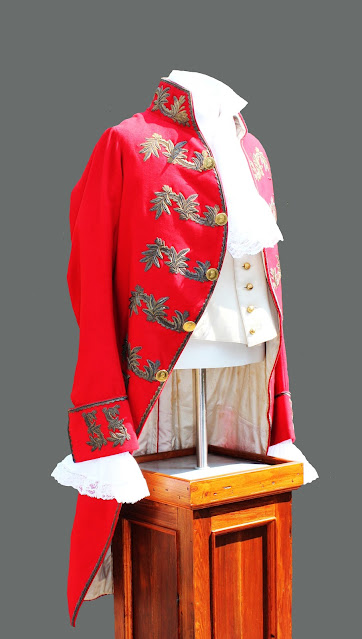
How did it look around 1819? I was making an artist impression when I received a call from a long-time friend and collector who came aware about my blue uniform. He told me that he knew someone with two old, that means over 200 years old, uniforms who had them in the family for almost half a century. It was years ago when he tried to buy them. But the owner was reluctant do so. In his recollection one of the uniforms was unusely long and red. I got the adres, made an appointment, and the man was very nice and willing to show me the uniforms. And there it was: the major scarlet dress tailored in 1819.

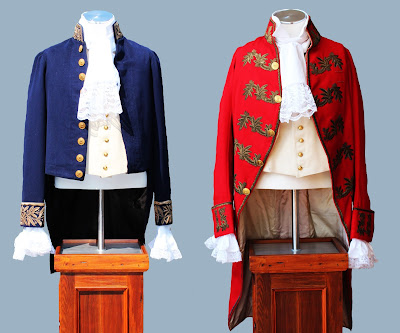
Uniform Ridderschap Utrecht


Did I get the opportunity to buy this dress from the man?. Yes. I have the piece but it was not a bargain.

What is it worth? Well, there are not many collectors who like such a typical Dutch object and can not sleep without the possession of it. So the blue minor coat is around 400 euro's allthough it is in prisitne condition. But on the other hand the red one is a piece of clothing ('habit de cour') arond the turn of the century while Napoleon still living. That has it's influence on the price more then collecting court dresses from the Netherlands,


Saturday, 4 February 2017

Dutch Court Sword / Staatsiedegen


If one collect Dutch court swords it seems you always find or see a type you do not have while you already have a considerable collection. It is save to say that you never will be complete or at least not be sure about it. The Dutch had there swords made by every possible maker in Europe. And by the Dutch is not meant the goverment but every single Dutchman who was allowed to wear a court sword.

The court sword was allways connected with a civil uniform. And all those uniforms where regulated by the state of The Netherlands. Every uniform is discribed by law and still exist today (exept for the Mayor uniform). The Dutch goverment however was as stingy as it can be and never issued one single uniform and court sword. You had to pay for them yourself.

The Dutch goverment only said the Dutch coat of arms had to be present with the motto Je maintiendrai. This gave the manufacturers the possibility to prelude on the overall design. And they did, by the hundreds. So every European sword maker had an example of a Dutch court sword. But to their, the Dutchman, great disapointment none of them was cheap. They all where in high quality with dito prices.

I show you three pieces of my own collection. 

Fig. 1.: It is not the design but the dragon and the white scrabbard. The white scrabbard was only used by a Diplomat and a Minister of Cabinet. But by attaching a M1948 dragon it can only be a diplomat of any rank within the diplomatic corps. Only Diplomats (since 1948) and Chamberlains (since 1897) had a dragon with their court sword. The court sword is made by E. and F. Köhler, Solingen. 

Fig. 2.: The sword has a scarce ivory grip. Some regulations state that the grip had to be of mother of pearl. In this case it seems a custom made sword where the regulations did not provide. The coat of arms has the lions looking you straight in the eyes. By 1907 the Dutch goverment redisigned the lions now looking to the shield. And all the manufactures followed that order with the consequence that todays collector of Dutch court swords has no longer any idea where it ends.

Fig. 3.: This is the only sword more or less prescribed in the regulations. It hat to be gold plated, have a gold plate top mount on the scrabbard of 9cm and a gold plated end mount of 12cm, mother of pearl grips. A dragon made of gold wire (M1897). All of this was drawn and was an offical part of the formal regulation. That meant the design of the sword was known. The hilt had to be near straight with an oval cross guard. So this is a Chamberlains court sword. On the blade there is the name of the dealer: A.A. Knuyver en Zonen Den Haag. Mister Knuyver started as court supplier at 1858.
There is an annoying thing about this sword. If you ever encounter the same type but without the dragon you can not say that it is a Dutch chamberlain court sword. All German manufaturers adopted this type as a regular one. Everybody could buy it but only for the chamberlain it was obliged. It only becomes a chamberlain sword with the M1897 dragon attched.

The dragon on most court swords ar fastened in a dubious way. The Dutch has regulations for the dragon on some infantry swords, Navy officer sword and the M1820 officer sword but not for the court swords for diplomats and chamberlains. The reason for this was a strong opposition from the members of the branches. If there was a court dinner all the court swords where piled up at the lobby. Afterwards every diplomat and chamberlain had to find out which court sword belonged to him. With no regultions on the knotting of the dragon, one personalized the knotting of the dragon to the extend that it was indeed becoming dubious. But now every diplomat and chamberlain could find his court sword without any doubt. 

Friday, 6 January 2017

Persian Diplomat Uniform


Hardly seen on the market a Persian uniform in an outstanding shape. A small dealer closed his business and I was only looking for the chest embroided ones. There where none but then he came with this uniform. It was Persian so much was clear, but the story behind the uniform was not clear at all. The dealer told me that he bought the uniform from Serné and Sons, Tailors, Amsterdam, Holland. The uniform was left at the tailor by it's owner around 1920 and he never collected it again. Serné opend his doors in 1866 and closed them in 1990. So the uniform was stored for 70 years waiting for this rightfull owner who never showed up.


The story leaves some questions. The uniform has three labels. Two are from Serné and the other one reads: DONNY, PAVILLON DE ROHAN, PARIS. Donny was the leading European tailor for Civil Uniforms. The house Donny presented it self as 'Specialité de Livrées'. And that means civil uniforms with rich embroidery. Donny, for some unkown reason to me, closed his 'Maison' around 1910. On the other hand the label of Serné is intersting too for the Dutch Coat of Arms shows two lions who are looking you straight in the eyes. The crest was alternate by law of 1907. By then the lions are facing en profile.
 

This means that the uniform was made in Paris before 1907. The button has a Qajar Coat of Arms. The tail of the lion had to be a S shape according a decree from 1910. The lion on the button has a straight tail. So this all indicates a uniform before 1907.


What had Serné to do with a Paris made Persian uniform before 1907 and kept it till 1990? There are some repairs to the uniform. Not on the outside but on some places the interior has other silk. Clearly it was damaged and Serné repleced some pieces. So before 1907 a Persian diplomat gave the uniform to Serné to repair the silk. The uniform is not from an ambassador. Those uniforms has the bottom side diagonal also embroidered. So it could be a Resident Minister or General-Consul. I found two pictures on the web that are close to the uniform.

Persian diplomat Ali Kuli Khan, 1913, Washinton D.C., Getty Images
 
Extraordinary and Plenipotentiary Minister Samad Khan Momtaz (middle), Persian diplomatic delagation 1910.
The man first left on the second row wears a similar uniform.
Samad Khan was minister for the Netherlands till 1905. After that he became extraordinary and Plenipotentairy Minister in Paris. Did Samad Khan leave his uniform to Serné in Amsterdam to repair and had no need for it when he became one step higher which acquired a more elaborate uniform? That would be nice but we will never know.
 
But there is something else. The Dutch had Persian General-Consuls situated in Amsterdam. Rich merchants who became honorary consuls. There where three of them during that period. From 1889 till 1902 Herman Hesse, from 1902 till 1906 A.M. de Block and finaly from 1906 till 1919 J.P. Nord Thomson. Why is this interesting? I found a picture of Nord Thomson wearing a General-Consul uniform of Persia.
 
Joseph Philip Nord Thomson (1859-1942)
That means that also non Persians where allowed to wear a Persian diplomatic uniform. It is a different uniform as we look to the embroidery so the uniform is not of that of Thomson. Then we have Hesse and Block left. I have no pictures of them so everything is still possible.
 
Some details of the uniform.
 
Back

Holding the belt on place

Chest


Friday, 14 October 2016

Civil Uniform Consul-General Model 1842 of The Netherlands/Ambtskostuum Consul-Generaal Model 1842

For over 25 years I collect civil uniforms. For two years ago I had around 60 uniforms. But there was one thing about them: the chest was not embroidered. If I showed my uniforms to a visitor he only saw 60 uniforms on row with only the cuffs and collar embroidered. That gave the visitor the idea that I had 60 identical uniforms. And he was right the fun was over for I did not have the real ones: the uniforms with the embroidered chests. So I made the decision to quit and I sold all my uniforms exept for the Inspector of Greenland. But then for some unknown reason or call it faith I was able the buy the first 'chest' at the beginning of 2016. And then it followed rapitly for an never heard of collector to me offered me 'chests' of The Netherlands. Some in a terrible shape and some in museum quality.

The Netherlands as far I can tell had 10 civil uniforms with the chest embroidered; 
  1. Civil uniform State Council, Model 1825, embroidery in silk. I can buy it but it is much to expensive for me.
  2. Civil uniform Minister, Model 1825, embroidery in gold wire, I only have a picture of it.
  3. Civil uniform State Council, Model 1842, embroidery in gold wire, Never seen it.
  4. Civil uniform Envoy, Model 1842, embroidery in gold wire, The collector is still hesitating to sell it to me.
  5. Civil uniform Consul-General, Model 1842, embroidery in silver wire, In my collection.
  6. Civil uniform Chamberlain, Model before 1852, embroidery in gold wire, In my collection.
  7. Civil uniform High Chamberlain, Grand Officer, Model before 1852, embroidery in gold wire, In my collection.
  8. Civil uniform Consul-General, Model 1908, embroidery in silver wire. In my collection.
The uniform of the High Chamberlain and Grand officer has the same design as it comes to the embroidery. But with the different branches of the Grand Officers the basic color of the uniform (black), became red with gold wire or green with silver wire. Of the red one only one exits and residates in Museum Palais Het Loo.

Here I will show you the civil uniform of the Consul-General Model 1842. It has the same embroidery as the Envoy Model 1842 but the Consul-General has silver wire and the Envoy gold wire.


But as you can see this Model 1842 differs from the general design.


The reason for this is the fact that the goverment of The Netherlands offered only the basic pattern.

So design number B. was the only thing the tailors had to work with. There was some agrement between tailors how to use the basic pattern. But that general design was not obligated by law. If some Consul-General had more or less money to spent it had his influence on the design. So if you ever encounter Dutch uniforms only look to the basic pattern.

The uniform is in a museum quality. But there is something else. I fit the uniform well! The Consul must be huge for his days for I am 1.85. It is the fist civil uniform I fit in 25 years.


Thursday, 13 October 2016

Civil Uniform Consul-General of The Netherlands/Ambtskostuum Consul-Generaal


One of the most beautifull uniforms of the Netherlands is the model 1908 civil uniform for a Consul-General. With rich embroidery in silver wire it was only outsmarted by the obscure uniform of a member of the State Council model 1825 and model 1842. This is one of my uniforms that is brand new. Not realy but in 100 years one can not see the influence of time. With the uniform came the original bicorn. It was a kind of a sarcophagus when I opend it. The label reads Theheran wich means that the consul was stationed in Persia. The bicorn has also a spare bullions in gold. Perhaps if the owner made promotion to envoy (The Netherlands did not know ambassadors in those times). The uniform of an envoy is however less ordinated but in gold wire.


Uniform Chamberlain in Her Majesty's Civil Household of the Netherlands/Kamerheer

 
I allready had the uniform of the High Chamberlain but four months ago I was able to obtain the Chamberlain. Completely torn up with all the buttons missing, but strange enough the scarce epaulettes where still there. It took the full four months to restore the uniform from a disaster into a beauty.


The State Museum of Amsterdam gave me some old pictures. They are in a high resolution so one can look closely to the details.

 
Since I have the two uniforms now it is nice to see the uniforms together in full glory. Enjoy.

As I bought them. Note the missing cuffs of the uniform on the right and all the buttons of the left uniform.

The old original buttons I bought years ago came now at hand. The missing velvet cuffs where hidden in the secret pockets of the tail of the jacket.

I could borrow the original Chamberlain Key from a collector to make the scene complete.

The uniforms in action during the crowing of Queen Juliana in 1948. It was the last moment in history the uniforms where actualy in use. Still they are never abolished by law and can be worn today although no Chamberlain does.